
For a young musician, travel can make history feel less distant. A place that once looked like a paragraph in a textbook becomes a city square, a museum gallery, a memorial wall, or a concert space filled with real people. That is the deeper value of the Red Tour 2027 with American Music Abroad.
Running June 30 to July 14, the Red Tour takes high school musicians through Belgium, the Netherlands, Germany, and Poland. Led by head director Mr. Gary Fink, with tour escort John Uhl, the experience begins at Hofstra University with rehearsals, orientation, and a farewell concert before departure. Students arrive as individual musicians, then begin forming the ensemble that will carry the tour’s performances across Europe.
Learning Begins Before the First Concert
American Music Abroad has spent 50 years creating performance-based travel experiences, with about 43,000 students and adults having traveled through its programs. That history matters to parents who want more than a loosely planned trip. The Red Tour is structured around rehearsals, concerts, guided visits, and cultural learning.
In Brussels, students experience music history at the Museum of Musical Instruments. The museum’s official “History of the MIM” page notes that the collection began in 1877 with a didactic purpose connected to the Brussels Royal Music Conservatory. For student performers, that kind of stop gives music a wider context. Instruments become part of culture, craft, and education.
This is what makes student performance tours with international concerts different from ordinary travel. Students are not just moving through cities. They are preparing, listening, learning, and then sharing music with international audiences.
History That Asks Students to Reflect
The Red Tour includes a meaningful World War II history component at Fort Breendonk. The official “Historical overview” page explains the fort’s transformation from a military structure into a prison camp during German occupation.
For students, a visit like this can be serious and sobering. It supports American Music Abroad’s Three Cs, Cathedrals, Concentration Camps, and Castles, by connecting performance travel with remembrance and historical education. Parents often value this balance because it helps students grow as thoughtful young adults, not only as musicians.
Culture Across Four Countries
The Netherlands portion adds a different kind of learning. Students encounter Delft pottery, the Kinderdijk windmills, the Peace Palace Visitors Center, Hague Tower, the Rotterdam Harbour Tour, and a Rotterdam walking tour. UNESCO’s page on the “Mill Network at Kinderdijk-Elshout” describes the area’s historic system of windmills, dikes, pumping stations, and water management, showing students how landscape, engineering, and culture are connected.
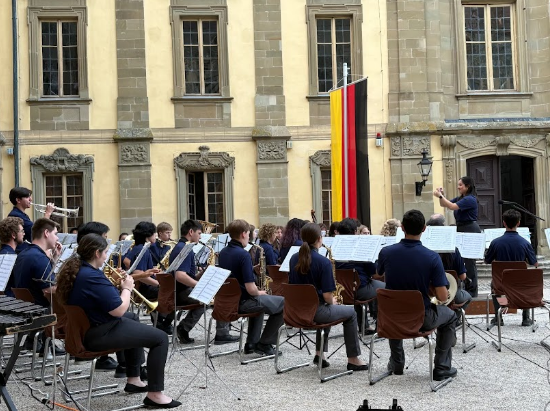
Germany then brings Hannover, Herrenhausen Gardens, Sea Life, Magdeburg, Berlin, and multiple performances. In Berlin, a short choir performance at Berlin Dom gives students a prestigious sacred setting. The official “Home” page describes the Berlin Cathedral as a monumental building with rich neo-Renaissance and neo-Baroque decoration.
Performance Makes Learning Personal
The Red Tour also reaches Szczecin, Poland, where students view the Karłowicz Philharmonic and visit the Pomeranian Castle courtyards. These experiences give the route a strong blend of architecture, performance, and city history.
For families considering music travel opportunities for high school musicians, the Red Tour offers a guided path through music, history, and personal growth. Students gain the confidence of performing abroad while experiencing cultural landmarks that make learning feel immediate.
Give History a Soundtrack Through Performance
Families interested in the Red Tour 2027 can reach out to us at American Music Abroad to learn how this student-centered journey blends concerts, history, and meaningful cultural discovery.